The FTC's fake reviews rule, explained for local businesses
Since October 2024 the FTC can fine businesses for fake, bought or suppressed reviews, and in December 2025 it sent its first warning letters. What the rule bans, what it allows, and how it fits with Google's and Yelp's own rules.
Key takeaways
- The FTC Rule on the Use of Consumer Reviews and Testimonials (16 CFR Part 465) took effect on October 21, 2024.
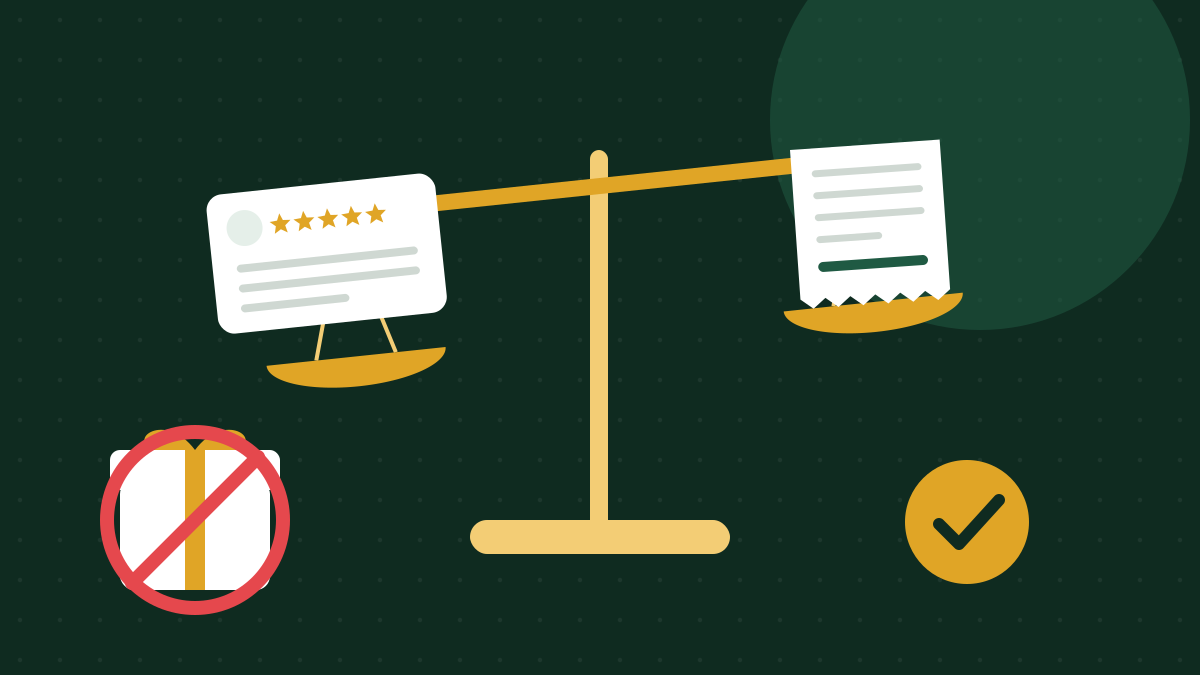
- It bans fake reviews, rewards tied to positive (or negative) reviews, undisclosed insider reviews and review suppression.
- Civil penalties can reach about $53,000 per violation; the FTC sent its first warning letters in December 2025.
- Asking all customers for reviews is fine. Google also bans incentives and asking only happy customers; Yelp asks businesses not to request reviews at all.
- The safest approach for a local business: ask everyone, the same way, with no rewards, and reply to every review.
For years, fake reviews were mainly a platform problem: Google, Yelp or Amazon removed them when they spotted them. That changed in the US in October 2024, when the Federal Trade Commission's rule on consumer reviews took effect. Now a business that buys, fakes or hides reviews can face civil penalties. Here's what the rule says, what it doesn't, and what it means for a restaurant, salon or shop in practice.
What happened
The FTC finalized its Rule on the Use of Consumer Reviews and Testimonials (16 CFR Part 465) in August 2024, and it took effect on October 21, 20241. Before the rule, the FTC could go after deceptive review practices under the general ban on deceptive practices in the FTC Act, but usually couldn't seek money penalties for a first offense. The rule changes that: violations can now carry civil penalties1.
In December 2025 the FTC sent warning letters to nearly a dozen companies, giving them a few days to confirm corrective steps. It was the agency's first public use of the rule as an enforcement tool, and the letters cited penalty exposure of up to $53,088 per violation2.
What the rule bans
In plain English, the rule covers six practices1:
- Fake reviews and testimonials: reviews by people who don't exist, who never used the business, or who misrepresent their experience. Writing them, selling them or buying them (when you knew or should have known) is banned. That includes AI-generated fake reviews.
- Rewards tied to sentiment: offering money, discounts, gift cards or freebies on the condition that the review is positive (or that a review about a competitor is negative).
- Undisclosed insider reviews: reviews by owners, managers or employees, or by their close family when specifically asked, without making the connection clear.
- Fake "independent" review sites: a website you control, presented as an independent source of reviews about your business.
- Review suppression: unfounded legal threats, intimidation or false accusations to stop or remove a review; or presenting the reviews you show as all the reviews you received, while hiding negative ones.
- Fake social media influence: knowingly buying fake followers or views to look more popular for commercial purposes.
What the rule allows
The FTC's own Q&A for businesses clarifies a few common questions3:
- You can ask for reviews. Routine, general requests to all customers are fine.
- Incentives are not banned by the rule itself, as long as there is no express or implied condition that the review be positive. Wording like "tell us how much you loved your visit" in exchange for a reward implies one. Undisclosed incentives can still be deceptive under the FTC Act.
- Asking only happy customers ("review gating") is not specifically banned by the rule, but FTC staff say it may still violate the FTC Act depending on the facts.
- You can moderate reviews on your own website for reasons that apply equally to all reviews regardless of sentiment, such as personal information or offensive content1.
The platforms are stricter than the FTC
For a local business, the platform rules matter just as much, because breaking them can get reviews removed or your listing penalized:
| Platform | Asking for reviews | Incentives | Asking only happy customers |
|---|---|---|---|
| Allowed, ideally to all customers | Banned (payments, discounts, free products or services)5 | Banned ("selectively soliciting positive reviews")5 | |
| Yelp | Businesses shouldn't ask for reviews6 | Banned | Banned |
| Tripadvisor | Allowed, with free request tools | Banned: incentivized reviews are removed7 | Not allowed to filter |
So even where the FTC rule would allow a non-conditional incentive, Google and Tripadvisor don't. The simple rule of thumb: no rewards for reviews, anywhere.
A 7-point checklist for local businesses
- Ask every customer, the same way. Not just the regulars who love you.
- No rewards for reviews. No discount, free coffee or prize draw, even "for any honest review".
- Never write reviews yourself or ask staff, friends or family to post them. If an employee reviews you, they must disclose it.
- Don't give customers a script to copy. Tell them where to leave a review, never what to write.
- Don't ask for Yelp reviews. Reply to the ones you get.
- Never threaten reviewers. If a review is fake or abusive, report it through the platform with clear reasons.
- If you show reviews on your website, don't hide the negative ones, and moderate by the same rules for all.
Frequently asked questions
Does the rule apply to small local businesses?
Yes. The rule applies to businesses in general, not only to big brands or online stores. If you're unsure about a specific practice, check with a lawyer.
Can I offer a discount to anyone who leaves a review, good or bad?
The FTC rule doesn't ban a reward that is truly not tied to sentiment, but Google and Tripadvisor ban incentives entirely, and Yelp doesn't want you to ask at all. In practice: don't.
Can I offer a private feedback channel?
Yes, as long as every customer still sees the public review option too. What's risky is screening customers first and sending only the happy ones to Google.
Can I ask a customer to update a review after I fixed their problem?
The FTC Q&A says asking satisfied customers to update their reviews isn't prohibited by the rule. Never offer anything in exchange, and never pressure them.
Can I use AI to reply to reviews?
Yes, replying is your own speech. What you can't do is use AI to write reviews. Read every AI reply before it goes out, especially on negative reviews.
The bottom line
The FTC rule, Google's policies and Yelp's guidelines all point in the same direction. Ask everyone, reward no one, hide nothing, and reply to every review. If you already work that way, you don't need to change anything. If you don't, the risk is no longer just a removed review: it can be a federal penalty.
This article is for general information and is not legal advice. For your specific situation, talk to a lawyer.
Sources
- Hogan Lovells, FTC publishes final rule banning fake consumer reviews and testimonials
- Benesch, Five stars, zero tolerance: FTC turns up enforcement under the Consumer Review Rule (April 2026)
- FTC, Consumer Reviews and Testimonials Rule: Questions and Answers
- Near Media, With $4.2M fine, FTC kills review gating (January 2022)
- Google, Prohibited and restricted content (fake engagement)
- Yelp Support, Don't ask for reviews
- BrightLocal, Review platform guidelines (Google, Yelp, Tripadvisor)
Sources checked on October 23, 2026. Platforms change often: if you spot something out of date, let us know.